






 Help Center




- Introduction
- The Spreadsheet is Your Biggest Bottleneck
- Turning Data Into a Decisive Edge
- Why Brands are Ditching the Manual Spreadsheet
- Under the Hood: How AI Price Optimization Actually Moves the Needle
- Industries Using AI Powered Price Optimization
- The Real Payoff: Why AI Price Optimization is a Growth Lever, Not Just a Tech Flex
- The Reality Check: Where AI Pricing Can Trip Up
- Don’t Just Turn It On: How to Actually Win with AI Price Optimization
- The Bottom Line: Pricing is No Longer a Guessing Game
- Frequently asked questions
Introduction

Let’s be honest: the days of “set it and forget it” pricing are dead. If you’re still relying on gut instinct or a dusty Excel sheet to decide what your product is worth today, you’re leaving money on the table – or worse, pushing your customers straight into a competitor’s arms.
In a market that moves this fast, AI Price Optimization isn’t just a “tech upgrade.” It’s a survival tactic.
AI Price Optimization helps businesses automatically adjust product prices using real-time data, demand signals, and competitor analysis to maximize profit. At Panda Boom, smart pricing strategies empower sellers to stay competitive and grow faster in dynamic marketplaces.
The Spreadsheet is Your Biggest Bottleneck
Why do traditional models fail? Because they’re reactive. They tell you what happened last month, not what’s happening at 2 PM on a Tuesday when your main competitor just dropped their rates.
This is where AI in price optimization actually earns its keep. Instead of looking backward, AI based price optimization processes millions of data points – from local demand surges to supply chain hiccups – and finds the exact “sweet spot” where your profit and customer loyalty meet.
Turning Data Into a Decisive Edge
You don’t need more data; you need better decisions. By leaning into AI powered price optimization, a business can finally stop guessing.
It’s about more than just a higher margin. It’s about agility. Whether it’s shifting a price by a few cents to capture a Amazon trends or holding steady when others panic, AI pricing optimization gives you a level of precision that a human brain – no matter how experienced – simply can’t match at scale.
Think of AI Price Optimization as a digital brain that never sleeps. While a human manager might check competitor sites once a week, these Amazon’s algorithms are pulse-checking the entire market every second. It’s the shift from “guessing” what a customer will pay to “knowing” based on live data.
Instead of a static sticker price, these systems juggle a dozen balls at once:
- How fast is your stock moving?
- Did your biggest rival just launch a flash sale?
- Is it raining? (Believe it or not, weather shifts demand).
- Is it the 30th of the month or the 1st?
By crunching these variables, AI based price optimization finds that narrow “Goldilocks zone” – not so high that you scare people away, but not so low that you’re leaving cash on the table. Unlike old-school methods, these models actually get smarter the more they “fail” or “succeed,” refining their math with every single transaction.
Why Brands are Ditching the Manual Spreadsheet

Pricing is arguably the most stressful lever in a business. One wrong move and your margins vanish or your customers revolt. This is exactly why AI pricing optimization is exploding right now.
Moving at the Speed of a Click
The digital market doesn’t wait for your Monday morning meeting. If a competitor drops their price at 2 AM, you’ve already lost eight hours of sales by breakfast. AI powered price optimization acts as an autopilot, adjusting your position instantly so you stay in the lead without lifting a finger.
Death to “Gut Feelings”
We’ve all been there – setting a price because “it feels right” or “that’s what we did last year.” That’s a recipe for stagnation. Using AI in price optimization replaces intuition with hard evidence. It looks at millions of rows of data that a human brain simply couldn’t process, spotting hidden trends in consumer behavior before they become obvious.
Protecting Your Bottom Line
Let’s talk numbers. We aren’t just talking about a few extra cents here and there. Precise, data-backed pricing can often bump profit margins by 5% or more just by capturing the value you were already providing but weren’t charging for.
Keeping the Customer Happy
It sounds counterintuitive, but better pricing actually helps loyalty. Nobody likes feeling “gouged,” but everyone loves a fair deal. By staying aligned with what the Amazon market actually expects, you ensure your brand stays a “no-brainer” choice for your audience.
Under the Hood: How AI Price Optimization Actually Moves the Needle
If you’ve ever wondered how a brand manages to change its prices three times in a day without losing its mind, you’re looking at AI Price Optimization in the wild. It isn’t just a fancy calculator; it’s a multi-stage engine that turns raw, messy data into a tactical advantage.
The Data Buffet
First, the system has to “eat.” It doesn’t just look at what you sold yesterday. It’s pulling in everything: what your rivals are charging right now, how many units are sitting in your warehouse, and even the subtle signals in how people are clicking around your site. This massive pile of info is the bedrock for any solid AI pricing optimization model.
Spotting the Invisible Patterns
Once the data is in, the machine learning kicks in. This is where the magic happens. A human might see a drop in sales and blame the weather; AI in price optimization might realize that sales actually dipped because a competitor 200 miles away offered free shipping for four hours. It finds the “why” behind the “what” that we usually miss.
Playing “What If?” (Forecasting)
This is my favorite part. The system runs thousands of simulations. “What if we drop the price by 4%? Will we sell 10% more, or will we just lose margin?” AI powered price optimization predicts that “sweet spot” before you ever risk a single dollar. It’s basically a crystal ball for your P&L.
Pulling the Trigger
Finally, it acts. In the time it takes you to read this sentence, the system can update a price tracking across ten platforms. This kind of AI based price optimization is why you’ll see flight prices or hotel rooms shift while you’re still looking at the tab.
It’s one thing to talk about math; it’s another to see it moving millions of dollars in a single afternoon. AI-powered price optimization isn’t just a “nice-to-have” for tech giants anymore. It’s the new baseline. If you’re not using it, you’re basically bringing a knife to a gunfight.
Industries Using AI Powered Price Optimization

E-Commerce: The Digital Wild West
In the world of online shopping, a price that worked at 10 AM is ancient history by noon. AI Price Optimization is the only way these platforms stay alive. They aren’t just looking at what you want to pay; they’re watching what every other site is doing in real-time. If a competitor drops their price by five cents, the AI catches it and pivots before you can even refresh your browser.
Retail: Beyond the Sticker Price
Don’t think this is just for websites. Even the big-box stores are leaning into AI pricing optimization to figure out why one aisle is moving and another is stagnant. They’re looking at foot traffic, local weather, and even “basket math” – realizing that if they drop the price of the printer, they can make it back by nudging the price of the ink.
Travel & Hospitality: The OGs of the Pivot
Airlines and hotels have been doing this for years, but now they’ve traded their old spreadsheets for high-speed engines. Using AI based price optimization, a hotel can see a concert announcement or a sudden demand spike and adjust room rates instantly. It’s why that flight you saw for $200 is suddenly $450 an hour later – the machine saw the demand coming before the human agent did.
Manufacturing: The Silent Shift
This is where it gets interesting. Manufacturers are finally ditching the “cost-plus” mindset. By using AI in price optimization, they can actually predict what their distributors are willing to pay based on raw material costs and global demand. It helps them stop leaving money on the table when demand is high and stay lean when things get quiet.
The Real Payoff: Why AI Price Optimization is a Growth Lever, Not Just a Tech Flex
If you’re on the fence about whether a piece of software should be touching your margins, you have to look at the “hidden” costs of staying manual. Implementing AI Price Optimization isn’t just about the fancy math – it’s about removing the friction that kills growth.
Speed as a Competitive Weapon
In a digital-first market, “fast” is an understatement. If your pricing team takes 48 hours to approve a change, you’ve already lost two days of revenue to the guy who automated his workflow. AI powered price optimization acts as your 24/7 eyes on the market, making calls in seconds that would take a human committee a week of meetings to finalize.
Squeezing the “Lost” Margin
Most businesses have a “gut feeling” about where their price should be, but they’re usually off by 2% or 3%. That might sound small, but on a million-dollar line, that’s $30,000 you just handed back to the market for no reason. AI based price optimization finds those tiny gaps where you could be charging more – or where a slight discount would actually trigger a massive wave of sales you’re currently missing.
Killing the “Human Error” Factor
Let’s be real: people get tired. They miss a competitor’s flash sale. They forget to adjust for a holiday weekend. They let ego get in the way of data. Relying on AI pricing optimization removes that volatility. You aren’t guessing anymore; you’re executing based on what the numbers actually show, not what you hope they show.
Scaling Without the Headcount
If you have five products, you can price them on a napkin. If you have 5,000? You’re in trouble. Trying to manage a massive catalog manually is a one-way ticket to burnout and bad data. Using AI in price optimization allows you to scale your marketing strategy across thousands of SKUs without needing to hire a small army of analysts to keep the lights on.
The Reality Check: Where AI Pricing Can Trip Up
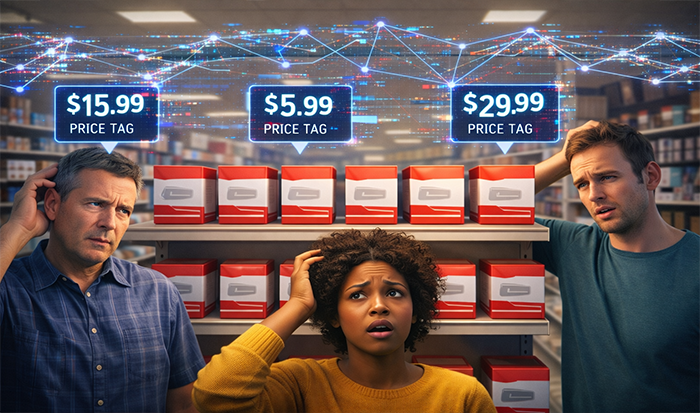
It’s easy to get swept up in the ROI, but implementing AI Price Optimization isn’t a “plug-and-play” miracle. If you don’t handle the groundwork, the system can actually work against you. Here’s where most businesses hit a wall:
The “Garbage In, Garbage Out” Trap
You’ve heard it before, but in pricing, it’s a literal dealbreaker. An AI is only as smart as the data you feed it. If your sales records are messy, or if your competitor tracking is pulling from outdated cached pages, your AI pricing optimization is going to spit out numbers that make no sense. You can’t just “automate” a mess; you have to clean the pipes first.
The Nightmare of the “Legacy” Stack
Most businesses aren’t starting from scratch. They’re dealing with ERPs and inventory systems that were built a decade ago. Trying to hook a high-speed AI powered price optimization engine into a slow, clunky legacy system is a massive technical headache. If these systems don’t talk to each other in real-time, the “optimization” part of the equation disappears.
Don't Just Turn It On: How to Actually Win with AI Price Optimization
If you treat AI Price Optimization like a “magic button,” it’s going to let you down. The tech is elite, but the strategy is still on you. To get the ROI everyone talks about, you need to move past the setup phase and into the “best practice” phase.
- Know Your “North Star”
Are you trying to clear out old stock, or are you trying to squeeze every cent of margin out of a premium line? You can’t do both at once. Before you even touch a line of code, you have to tell the system what “winning” looks like. Without clear goals, your AI pricing optimization is just a fast car with no steering wheel.
- The “Human in the Loop” Rule
Automation is great until it isn’t. You can’t just walk away and hope the algorithm understands a sudden global event or a PR crisis. Human oversight is the safety net. You need to be checking the dashboard regularly to make sure the AI based price optimization isn’t hallucinating a trend that doesn’t exist in the real world.
- Data is a Moving Target
Machine learning isn’t a one-and-done setup. If you’re feeding it the same stale datasets from three years ago, you’re going to get three-year-old results. To keep AI powered price optimization sharp, you have to constantly feed it fresh, high-quality data. The more it “sees,” the more it learns where the retail market is actually going.
- Marrying Math with Intuition
Data is powerful, but it doesn’t have “gut feeling.” The most lethal strategy is a hybrid: use the AI in price optimization to handle the millions of micro-adjustments, but keep a human strategist in the room to handle the big-picture context that a machine simply can’t “feel.”
The Bottom Line: Pricing is No Longer a Guessing Game

At the end of the day, pricing is the most powerful lever you have for growth, but it’s also the easiest one to break. We’re moving into a world where “gut feeling” is a liability. AI Price Optimization isn’t just a shiny new toy for the IT department; it’s the difference between a business that’s reacting to the market and one that’s actually leading it.
Whether you’re in the chaos of e-commerce or the high-stakes world of manufacturing, the goal is the same: stop leaving money on the table. By leaning into AI powered price optimization, you’re giving your brand content the agility to pivot in seconds, not weeks.
The shift toward AI pricing optimization is already happening. The companies winning right now are the ones that realized a static spreadsheet can’t compete with a real-time engine. Embracing AI based price optimization today isn’t just about a better margin tomorrow – it’s about making sure you’re still in the game five years from now.
If you want to stay relevant in a data-driven economy, it’s time to let AI in price optimization do the heavy lifting so you can focus on the big picture.
Frequently asked questions
1. What exactly is AI Price Optimization?
Think of AI Price Optimization as a 24/7 digital brain that’s obsessed with your margins. While a human manager might check a competitor’s site once a week, these algorithms are pulse-checking the entire market every second. It’s the shift from “guessing” what a customer might pay to “knowing” based on live data, inventory levels, and even things like the weather or the time of day.
2. How does AI powered price optimization actually move the needle for a business?
The biggest win isn’t just a higher price tag – it’s agility. Because AI powered price optimization reacts in seconds, not weeks, you stop leaving money on the table. Whether it’s catching a sudden demand surge or realizing that a 2% discount would trigger a massive wave of sales, it turns your pricing into a proactive growth lever rather than a reactive chore.
3. Which industries are leaning into AI based price optimization the most?
It started with the “heavy hitters” in travel and e-commerce, but it’s spreading everywhere. Today, you’ll see AI based price optimization being used in retail to manage “basket math,” in hospitality to fill rooms during slow weeks, and even in manufacturing to help teams move past the old “cost-plus” mindset and price based on real-time global demand.
4. Is AI in price optimization really that much better than the old-school ways?
Honestly? It’s not even a fair fight. Traditional methods are like looking in the rearview mirror; they tell you what happened last month. AI in price optimization is looking through the windshield. It processes millions of data points that a human brain simply can’t handle, spotting hidden trends and predicting customer behavior before it even happens.


