








 AMZ Sales Booster

















 Avg. +47% organic sales
 HELP CENTER


- Understanding the Amazon Buy Box Beyond the Basics
- Why Amazon Buy Box Win Rate Statistics Matter So Much
- How Amazon’s Buy Box Algorithm Thinks
- Pricing Data and Buy Box Amazon Performance
- Fulfillment Data and the Reality of FBA vs. FBM
- Seller Performance Metrics and Buy Box Eligibility
- Inventory Availability and Buy Box Stability
- Shipping Speed and Its Statistical Impact
- Customer Feedback and Buy Box Performance Data
- Buy Box Rotation and Why Ownership Changes
- Category-Level Buy Box Competition Insights
- Mobile vs Desktop Buy Box Behavior
- How Sellers Can Use Buy Box Data Strategically
- What Amazon Buy Box Statistics Mean for Scaling Businesses
- Conclusion – What Can Sellers Understand from Data Regarding the Amazon Buy Box?
- Frequently asked questions
Understanding the Amazon Buy Box Beyond the Basics
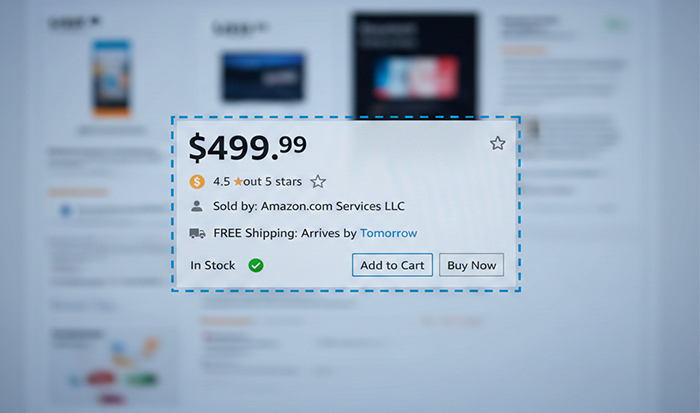
The Amazon Buy Box is often misunderstood as a simple feature on a product page, but in reality, it represents Amazon’s trust mechanism. When multiple sellers offer the same product under a single ASIN, Amazon must decide which seller deserves to be recommended to the buyer. The Buy Box is that recommendation.
The majority of consumers will not scroll down while shopping to compare different sellers but are instead looking to Amazon to do this for them. Years of purchasing history demonstrate that consumers will purchase based on convenience, speed, and trust, with little regard for price comparison.
Consequently, sellers listing in the Buy Box are going to receive nearly all conversions, while other sellers will do everything possible to get noticed by consumers.
For sellers, this creates a clear divide. Those who consistently win the Buy Box Amazon placement benefit from predictable sales and stronger product ranking signals. Those who do not often experience sudden drops in revenue, even when their listings remain indexed and optimized.
Why Amazon Buy Box Win Rate Statistics Matter So Much
Statistics provide clarity where assumptions fail. Many sellers believe that Buy Box success depends solely on price, but data paints a very different picture. Industry-wide analysis shows that more than 80 percent of desktop purchases and over 90 percent of mobile purchases are completed through the Buy Box.
Buy box ownership is not merely a benefit, It is a fundamental component of what drives sales growth on Amazon for sellers today. Sellers who proactively track the changes in their overall buy box win rates are able to more quickly identify issues, make adjustments to their pricing strategies, and ultimately, preserve their profit margins.
Amazon is not just a “one-time” optimization that allows you to win the buy box; it is a continuous process of optimizing your pricing policies and promotional items. Data reveals that Buy Box performance is dynamic and influenced by daily operational decisions, which makes consistent monitoring essential for sustainable growth.
How Amazon’s Buy Box Algorithm Thinks
Amazon’s Buy Box algorithm is built to reduce customer friction and minimize risk. Every factor evaluated by the algorithm serves one purpose: delivering the best possible buying experience with the least chance of failure.
Rather than favoring sellers who offer the lowest price at any cost, Amazon prioritizes sellers who demonstrate reliability. This includes consistent shipping performance, low error rates, strong customer feedback, and inventory stability. Price is important, but only when it aligns with these broader trust signals.
Sellers who understand this mindset stop treating the Buy Box as a competition against other sellers and start treating it as a competition against Amazon’s expectations.
Pricing Data and Buy Box Amazon Performance
While pricing continues to be one of the most important Buy Box factors, many sellers misinterpret how it works within Amazon’s pricing structure. When evaluating who gets the Buy Box, Amazon looks at the “landed price” of the product, which consists of the product’s selling price (the seller’s price), shipping fees, and delivery speed. As a result, a seller who has slightly higher priced products but faster delivery options may be more successful than a seller whose products are priced lower but offer slower delivery times.
Buy Box Win Rate Based on Pricing Position

These numbers show that aggressive price cutting is not always necessary. In many cases, sellers damage their margins without improving Buy Box stability. Data-driven sellers focus on staying competitively priced rather than being the cheapest.
Fulfillment Data and the Reality of FBA vs. FBM

The FBA vs. FBM comparison is one of the clearest examples of how data shapes Buy Box outcomes. Fulfillment method directly affects shipping speed, customer satisfaction, and Amazon’s confidence in the seller.
Buy Box Performance by Fulfillment Method
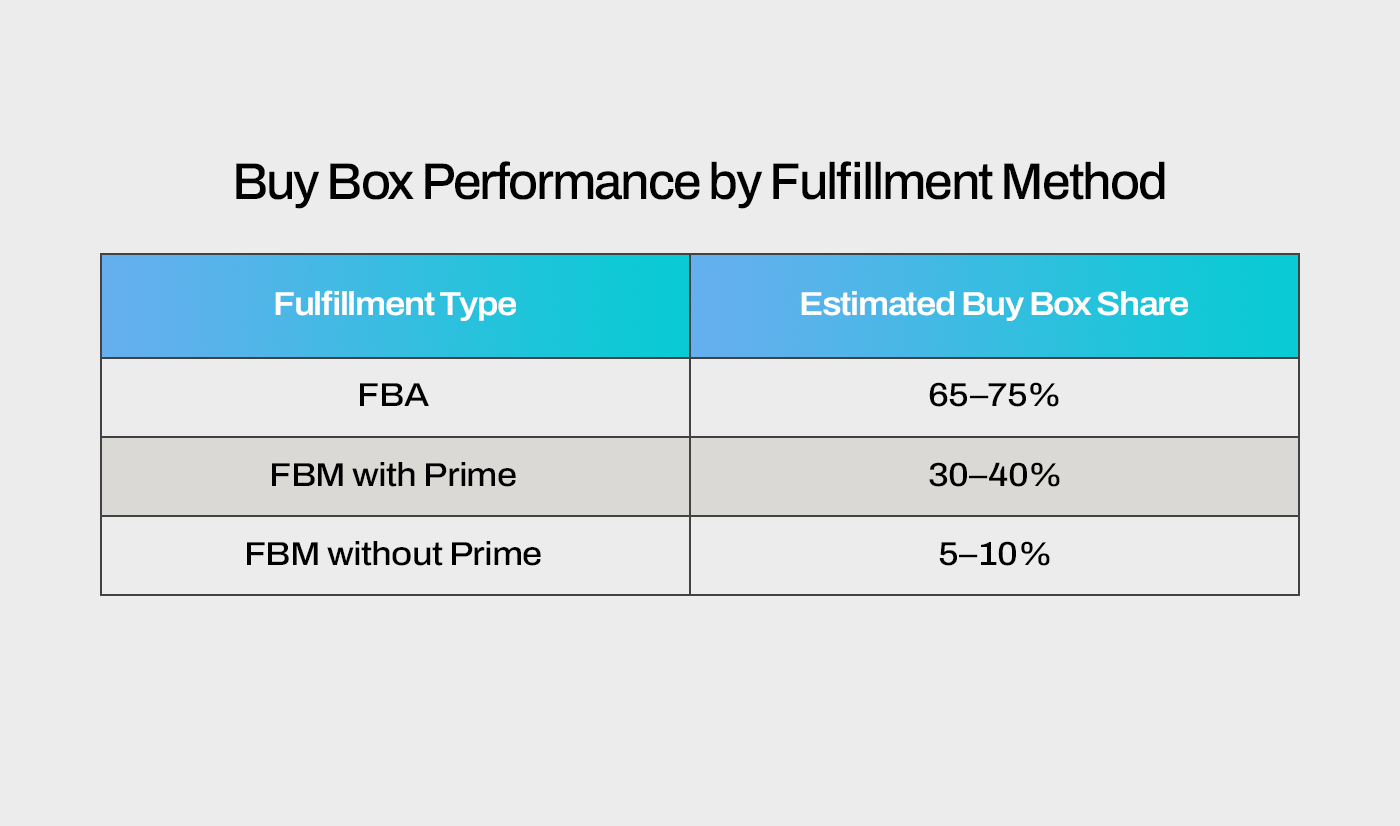
FBA sellers benefit from Amazon-managed logistics, predictable delivery timelines, and streamlined returns. This reduces risk for Amazon and increases Buy Box eligibility. FBM sellers can still compete, but the data shows they must operate with near-perfect performance to do so consistently.
Seller Performance Metrics and Buy Box Eligibility
Seller performance metrics act as Amazon’s quality control system. Metrics such as order defect rate, late shipment rate, and cancellation rate directly influence Buy Box eligibility.
What the data shows is that Buy Box success is cumulative. Sellers who maintain strong metrics over time are rewarded with more frequent Buy Box rotation. Sellers who experience repeated performance issues may lose Buy Box access entirely, regardless of price or fulfillment method.
Key performance indicators Amazon monitors include:
- Order Defect Rate below 1%
- Late Shipment Rate below 4%
- Pre-fulfillment Cancellation Rate below 2.5%
- Consistently healthy account status
Maintaining these benchmarks is essential for long-term Buy Box Amazon success.
Inventory Availability and Buy Box Stability
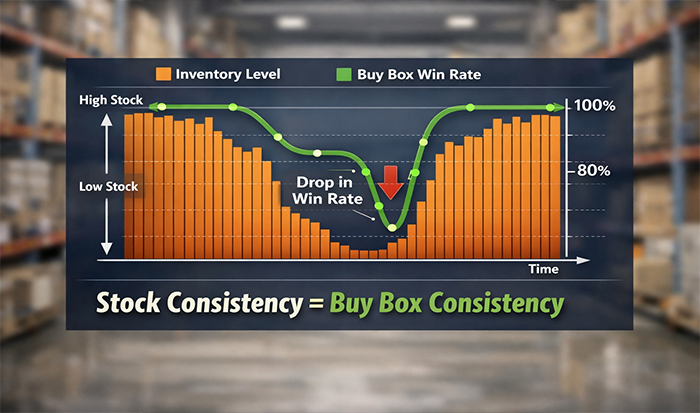
One of the most frequently overlooked areas of inventory management is how large of a factor it can play in Buy Box success. Amazon will always favour sellers that can keep their inventory stable and that do not have too many out-of-stock products.
Data on Buy Box fluctuations suggest that sellers with regular producing levels of inventory have less disruption to their Buy Box, have higher conversion rates, and have stronger ranking signals than those that do not have consistent inventory levels. Conversely, sellers that have too many out-of-stock products demonstrate that they must wait before being eligible for any kind of Buy Box.
Amazon values predictability. Sellers who demonstrate long-term reliability in inventory planning are more likely to retain Buy Box visibility during competitive periods.
Shipping Speed and Its Statistical Impact
The speed at which an item is shipped correlates directly with customer satisfaction and sellers’ potential to win the “Buy Box.” Prompt package delivery increases the likelihood that a customer will place an order, leave feedback and become a repeat customer. Due to this reason Amazon places a significant emphasis on the ability of sellers to meet the expected delivery timeframes.
Amazon has consistently proven that Prime-enabled offers outperform slower shipping options across all platforms, particularly on mobile devices due to the difficulty in finding alternative sellers. Fast shipping can significantly increase a seller’s chances of winning the Buy Box Amazon even if their prices are not the lowest available.
Customer Feedback and Buy Box Performance Data
Customer feedback is a significant factor in determining which merchant is awarded the Buy Box, this is because customers base their feedback on the quality of service provided by the seller. A seller that receives a large number of positive reviews has demonstrated sufficient trustworthiness to warrant being awarded the Buy Box.
Seller Rating vs Buy Box Probability

Negative feedback, unresolved claims, or poor return handling can quietly reduce Buy Box exposure over time.
Buy Box Rotation and Why Ownership Changes
Buy Box ownership is not permanent. Amazon rotates the Buy Box among eligible sellers to maintain pricing competitiveness and ensure inventory availability.
Rotation frequency depends on:
- Number of competing sellers
- Fulfillment method
- Pricing changes
- Inventory levels
- Seller performance consistency
Understanding this rotation helps sellers avoid panic pricing and focus on maintaining eligibility rather than chasing short-term wins.
Category-Level Buy Box Competition Insights

The Purchasing Behavior varies Quite Widely based on the different types of “Products”. Within highly competitive categories, especially within electronics and branded resale categories, sellers are forced into a ‘buy box battle’ due to the popularity of both the sellers and the products. On the other hand, in regard to Private Label Sellers, these sellers will typically find themselves competing with very few, if any, competitors for the ‘Buy Box’.
This will allow the sellers to analyze specific trends within their respective categories and use that data to make better-informed decisions on Pricing, Fulfillment Options, and Inventory Availability.
Mobile vs Desktop Buy Box Behavior
Mobile traffic now accounts for a large share of Amazon sales, and Buy Box dependency is even higher on mobile devices. On smaller screens, customers rarely view alternative offers.
Data shows that losing Buy Box visibility on mobile can result in immediate boost conversion drops, regardless of organic rank or advertising spend.
How Sellers Can Use Buy Box Data Strategically
Data-driven sellers make informed decisions based on information collected from multiple data sources and from their own Auction results. Using this information, they are able to notice problems or opportunities at an earlier stage and respond with the appropriate action.
Some of the main activities of the data-driven seller are:
- Setting competitive pricing that still allows for a profit
- Evaluating the proper method of fulfilling orders
- Actively monitoring inventory levels and taking action to replenish if necessary
- Protecting account health
- Improving customer experience consistently
What Amazon Buy Box Statistics Mean for Scaling Businesses
For growing brands, Buy Box data analytics provides clarity and control. Sellers can use it to create forecasts of their revenue, spot weaknesses in their operations, and scale operations while minimising risk.
Sellers that understand the Buy Box Amazon statistic will have a competitive edge in achieving sustainability with their business and maintaining future profitability.
Conclusion – What Can Sellers Understand from Data Regarding the Amazon Buy Box?

The data indicates that the Amazon Buy Box represents the largest single influence on a seller’s overall performance on Amazon. Sellers that can understand how to leverage pricing dynamics, fulfilment advantages, and performance metrics will perform better than their competition.
Sellers that win the Buy Box on Amazon do so through consistent and reliable business practices and data-driven decisions, which is what Amazon is built to support.
Frequently asked questions
1. How much do sellers actually depend on the Amazon Buy Box for sales?
Most sellers know that the majority of their sales come through the Amazon Buy Box, particularly with mobile shoppers who generally do not look at all available offers.
2. Why does losing the Buy Box Amazon hurt sales so quickly?
When you lose the Buy Box Amazon, customers don’t see your offer first, so clicks and orders drop almost immediately.
3. What really helps in Winning the Buy Box Amazon consistently?
From experience, Winning the Buy Box Amazon comes down to balanced pricing, clean account health, and dependable shipping.
4. In real situations, how does FBA vs. FBM affect Buy Box results?
In almost every instance, FBA is treated better than FBM by Amazon because of the level of confidence Amazon has in FBA shipping compared to seller-handled fulfillment.
5. Do sellers keep the Amazon Buy Box once they win it?
No, the Amazon Buy Box is a rotating opportunity and sellers can only retain ownership of it when their overall performance is strong.


