








 AMZ Sales Booster

















 Avg. +47% organic sales
 HELP CENTER



- Why Choosing The Right Amazon Product Categories Makes or Breaks Your Business
- The Complete Amazon Product Categories List: What You Need to Know
- Top Selling Categories on Amazon: Where The Money Actually Is
- Amazon Niche Products: Finding Your Hidden Gem
- How to List Products on Amazon in The Right Category
- Common Category Mistakes That Kill Your Sales
- Conclusion
- Frequently asked questions
Why Choosing The Right Amazon Product Categories Makes or Breaks Your Business

Let me ask you something real quick: how many nights have you spent staring at your laptop, scrolling through that endless Amazon Product Categories list, feeling like you’re trying to crack some kind of secret code? Yeah, I’ve been there. Every new seller hits this wall, and here’s the brutal truth: most pick wrong.
They see “Electronics” and think “huge market means huge money,” or click “Books” because hey, that’s where Amazon started. Next thing they know, their product’s buried on page 47 and they’re wondering what went wrong.
Here’s what nobody tells you: picking your category isn’t just some dropdown menu you rush through to List Products on Amazon. It’s everything. I’m talking about your competition level, your fees, your ad costs, and even whether Amazon’s algorithm decides to show your product to a single soul. I’ve watched sellers with average products absolutely crush it because they picked the right category. And I’ve seen genius-level products die slow, painful deaths because they got stuck in the wrong one.
At Panda Boom, we’ve walked hundreds of sellers through this minefield. And I’m not gonna give you the same recycled advice those free PDF guides spit out (you know, the ones that are just trying to upsell you a $997 course).
We’re talking real data, strategies that actually work, and the honest, no-BS pros and cons of each major category.
The Complete Amazon Product Categories List: What You Need to Know
First things first, let’s get our bearings. The Amazon Product Categories List is huge-like, “holy crap I didn’t know there were this many types of spatulas” huge. More than 30 main categories branch into thousands of subcategories. In fact, Amazon doesn’t even publish a complete public list because it changes constantly. It’s like trying to map a river that’s still flowing.
- The main Amazon categories you probably know
Electronics, Clothing, Home & Kitchen, Beauty, Sports & Outdoors, Toys, Books, all that. But each one breaks down into subcategories, then sub-subcategories, until you’re staring at something like “Home & Kitchen > Kitchen & Dining > Kitchen Utensils & Gadgets > Specialty Tools & Gadgets > Avocado Slicers.” That’s a real path, by the way. And yeah, someone’s making six figures selling avocado slicers. Wild, right?
The trick isn’t just picking a category-it’s picking the right level. Go too broad, and you’re duking it out with brands that have million-dollar ad budgets and lawyers on retainer. Go too narrow, and maybe 12 people a month are searching for it.
The sweet spot is somewhere in the middle, and finding it takes both data and a gut feeling.
Main categories vs subcategories, and why this matters more than your product
Okay, real talk: most sellers mess this up big time. They list their product in a main category and call it a day. Huge mistake. The Categories on Amazon work like a funnel, and you want to be in the smallest relevant subcategory that still gets traffic.
Why? Because Amazon treats subcategories like separate little kingdoms. You can be the king of “Kitchen Utensils & Gadgets” but a peasant in the massive “Home & Kitchen” empire.
Let me tell you about a client we had. Selling premium silicone baking mats. Listed under “Home & Kitchen”—you know, the category with like 40 million products.
Their best rank? 48,000. Not great. We then moved them to “Home & Kitchen > Kitchen & Dining > Bakeware > Baking Mats & Silicone Liners.” Boom. Their rank jumped to #12 in that subcategory, and their sales tripled in three weeks. Same exact product. Same price. Just better categorization.
The Amazon Product Categories List is essentially your treasure map. Each subcategory has its best-seller list, its customer expectations, its level of competition. Master the subcategory game, and you can own a little niche that feeds you for years while everyone else fights to their deaths in the main arena
Top Selling Categories on Amazon: Where The Money Actually Is

All right, cut to the chase. What you really want to know is what the top-selling categories are on Amazon. Here they are: Electronics, Home & Kitchen, Beauty & Personal Care, Clothing, and Books.
But, and it is a massive but, that doesn’t mean you should jump into those either. These categories are where the most money flows, sure, but also where the most sellers go to die.
The Top Selling Categories on Amazon attract every new seller with a pulse. Competition is absolutely brutal.
You’re not just competing with other small sellers; you’re going up against Amazon Basics, Anker, Samsung—brands that spend more on lunch than you’ll spend on inventory this year. But yeah, the volume is there. So if you can carve out a niche, the upside is unlimited. It’s high risk, high reward.
Electronics: The High-Volume, Low-Margin Meat Grinder
Electronics is the category everyone dreams about. “Huge margins!” they think. Nope. Electronics is actually a low-margin bloodbath for most sellers.
The Top Selling Categories on Amazon data shows Electronics moves massive volume, but you’re competing with direct-from-China sellers operating on 5% margins, brands with exclusive distribution deals, and Amazon itself, undercutting everyone.
The exception? Accessories. Phone cases, charging cables, laptop stands—that’s where small sellers can actually win. It’s all about finding that unserved micro-niche. Instead of “iPhone cases,” go for “iPhone cases for construction workers” or “wireless chargers for minimalist desk setups.”
The Amazon Product Categories path matters here: Electronics > Accessories & Supplies > Audio & Video Accessories > TV Accessories > TV Stands & Media Storage. That’s how specific you need to get to have a fighting chance.
Home & Kitchen: The Sweet Spot for Normal People
If I had to recommend one category for new sellers, it’s Home & Kitchen. Hands down. This is the most forgiving Amazon Product Categories playground. Why? It’s super fragmented. No single brand dominates.
Customers are actually open to trying new stuff. And the subcategory structure is so deep that you can find profitable niches everywhere.
The Top Selling Categories on Amazon reports consistently show Home & Kitchen products have steady demand, reasonable return rates, and customers who actually read listings (imagine that!).
We’ve seen sellers succeed with everything from specialty spice racks to magnetic fridge organizers to collapsible colanders. The trick? Solve a specific kitchen frustration that hasn’t been solved well yet.
The Amazon Product Categories List for Home & Kitchen is your best friend. For instance, sub-niches will be “Kitchen Utensils & Gadgets”, “Storage & Organization”, and “Dining & Entertaining”.
Find products with Best Seller Rank from 3,000 to 10,000 in the main category but still below 100 reviews.
That’s your golden window.
Beauty & Personal Care: The Subscription Goldmine (If You Can Get In)
Beauty is where you go if you understand branding and customer lifetime value. The Categories on Amazon for beauty are unique because they thrive on repeat purchases. Get someone to love your vitamin C serum, and they’ll buy it every 60 days for years. It’s like printing money.
But beauty is also heavily gated. Many subcategories require approval, lab tests, compliance documentation—the works.
The Amazon Product Categories path here is: Beauty & Personal Care > Skin Care > Face > Treatments & Masks > Sheet Masks. Each level has different requirements and different headaches.
The profit margins in beauty can be 60-80% if you private-label effectively. However, you need to understand ingredients, trends, and how to read a Certificate of Analysis. This isn’t a category for winging it. But if you get it right, the Amazon Niche Products in beauty can build you a seven-figure business with customers who are weirdly loyal.
Amazon Niche Products: Finding Your Hidden Gem

Here’s where the real money is made: Amazon Niche Products in categories most sellers ignore. Everyone fights over phone cases, but who’s dominating the “industrial & scientific” category for dental lab equipment? Who owns the “arts, crafts & sewing” subcategory for leatherworking tools? These are the hidden goldmines that nobody talks about at seller meetups.
Finding profitable Amazon Niche Products requires a different mindset. Instead of asking “what’s popular?” ask “what’s underserved?” The best niches have three things: consistent but not crazy demand (steady sales, no fad risk), low review competition (top sellers have under 500 reviews), and a clear customer pain point you can solve better than anyone else.
How to Identify Underserved Categories Without Losing Your Mind
Start with the Amazon Product Categories List, work your way down until you reach subcategories that have less than 10,000 products and consistent Best Seller Ranks. Using tools such as Helium 10 or Jungle Scout, filter to find products that sell 10-30 units per day with under 100 reviews, and that’s your sweet spot.
- Another trick
read the negative reviews on top products. If you see the same complaint repeated – “breaks easily”, “too small”, “hard to clean” that’s your product development roadmap. Create a version that fixes that complaint, list it in the same Categories on Amazon, and you’ll steal market share fast.
The Amazon Niche Products strategy works because big brands ignore small categories, and small sellers don’t think to look there. We’ve seen clients build six-figure businesses in categories like “Toys & Games > Learning & Education > Flash Cards > Anatomy” or “Sports & Outdoors > Outdoor Recreation > Camping & Hiking > Backpacking & Camping Stoves > Wood Stoves.” Specificity is your shield against competition.
The Danger of Overly Broad Categories (Don’t Do This)
Let me save you from a painful mistake: never list in a broad category just because it has high traffic. “Clothing, Shoes & Jewelry” gets millions of searches daily, but your new t-shirt brand will be buried on page 847. The Categories on Amazon reward specificity, not ambition.
- Amazon’s algorithm
Broad categories also attract the wrong customers. If you sell high-end hiking boots but list them under general “Shoes,” you get traffic from people looking for $20 sneakers. They click, see your $180 price tag, and bounce.
This kills your conversion rate, which tells Amazon your listing is garbage, which drops your rank further. It’s a death spiral.
- Instead, go deep
Clothing, Shoes & Jewelry > Men > Shoes > Athletic > Outdoor > Hiking & Trekking > Boots. Now you’re only competing with other hiking boots, and customers are finding you are actually looking for what you sell. Your conversion rate jumps, Amazon’s algorithm smiles upon you, and your rank climbs. Magic.
How to List Products on Amazon in The Right Category
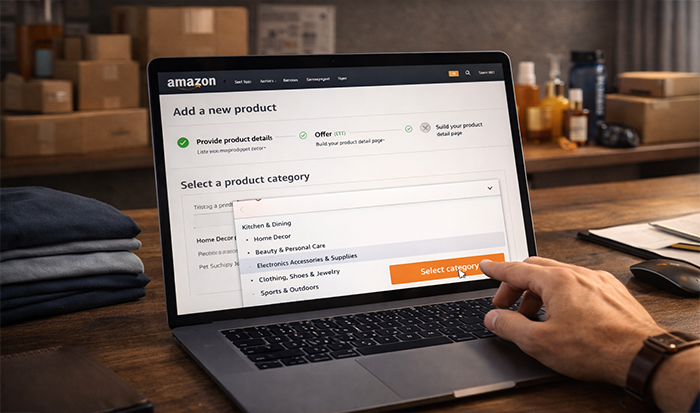
How to List Products on Amazon in the optimal category isn’t just clicking a dropdown menu. It’s a strategic decision that should happen during product research, not after you’ve already manufactured 5,000 units. The process starts with understanding where your product fits in the Amazon Product Categories List, not where you think it should go.
First, search for your main competitors and note their category paths. Don’t just look at one—look at the top ten sellers. If they’re all in different subcategories, that’s a red flag that the category structure is ambiguous. In that case, test different categories with small inventory batches before committing your full stock.
Second, use Amazon’s Product Classifier tool in Seller Central. It suggests categories based on your product name, but treat these as starting points, not gospel. The algorithm often suggests broad categories that maximize Amazon’s fees but minimize your visibility. Always drill down at least three levels deeper than the initial suggestion.
Third, check the category-specific requirements. Some Amazon Categories require approval (gated categories), some have specific image requirements, and some charge different referral fees. Beauty might charge 15% while Electronics charges 8%. That 7% difference can eat your entire margin if you’re not careful.
Common Category Mistakes That Kill Your Sales
I’ve seen sellers make every category mistake in the book, and some are so subtle they don’t realize it for months. The most common? Miscategorizing because of keyword confusion. Just because your product can be used for something doesn’t mean it belongs in that category.
A storage bin can be used in offices, garages, and closets, but when you list it in “Office Products” when all the search traffic is in “Home & Kitchen > Storage & Organization”, well, you’ve just ghosted yourself.
Another killer mistake is ignoring category-specific attributes. Each Amazon Product Category has required fields—material, dimensions, voltage, age range, etc. Skip these, and your listing gets suppressed. Fill them incorrectly, and you attract the wrong customers. Professional Amazon Product Listing Services spend hours getting these details right because they know one wrong attribute can kill 30% of your traffic.
Changing categories too frequently is another death sentence. Amazon’s algorithm needs time to understand where your product fits. If you keep switching categories, trying to find magic, you confuse the algorithm and reset your ranking momentum each time. Pick your category, commit to it for at least 90 days, and optimize everything else before considering a change.
Conclusion

Finding profitable Amazon Product Categories isn’t about following trends—it’s about strategic positioning. The Top Selling Categories on Amazon might look tempting, but the real money is often in the overlooked subcategories where you can dominate without fighting giants. Your category choice determines your competition, your customers, and ultimately, your success.
The Amazon Product Categories List is more than a navigational tool; it’s a treasure map. Learn to read it properly, and you’ll discover Amazon Niche Products opportunities that feed your business for years. Treat category selection as an afterthought, and you’ll join the graveyard of sellers who blamed their product when their real problem was placement.
Stop asking “what should I sell?” and start asking “where can I win?” The answer lives in the subcategories, the niches, the specific paths that most sellers scroll past. Your million-dollar product isn’t in the obvious places—it’s hiding where nobody else is looking. And if you need help decoding the map, that’s exactly what we do at Panda Boom.
Frequently asked questions
1. How do I know if a category is too competitive?
Check the top 10 products. If they all have 1,000+ reviews and major brand names, it’s too competitive. Look for categories where top sellers have 100-500 reviews and steady sales ranks between 1,000-10,000.
2. Can I list my product in multiple categories?
No, each ASIN gets one primary category path. You can sometimes get Amazon to add a secondary category through Seller Support, but it’s rare and requires strong justification.
3. What are gated categories and how do I get approved?
Gated categories require Amazon’s approval to sell in. These include Beauty, Grocery, Jewelry, and others. You need invoices from legitimate suppliers, compliance documents, and sometimes a performance history. Start with ungated categories to build your seller metrics.
4. Do category fees vary that much?
Yes. Referral fees range from 8% (Electronics) to 20% (Jewelry). Some categories have $2 minimum fees. Calculate your margins after fees before choosing a category.
5. Should I avoid seasonal categories?
Not necessarily. Seasonal Amazon Product Categories can be extremely profitable if you time inventory right. The key is having an exit strategy and not getting stuck with off-season inventory that kills your cash flow.


