








 AMZ Sales Booster

















 Avg. +47% organic sales
 HELP CENTER



- The Strategic Intersection: Amazon Brand Registry and Your Shopify Storefront
- Why Brand Protection Matters
- Choosing Your Platform: Shopify vs. Amazon
- Navigating the Dual Path: Shopify and Amazon Brand Registry
- The “Human-First” Strategy: 2026 Brand Growth
- Strategic Verdict: The Hybrid Approach
- The “Shield and Home” Strategy: 2026 Reality
- Why Enrollment is Non-Negotiable This Year
- Frequently asked questions
The Strategic Intersection: Amazon Brand Registry and Your Shopify Storefront

Most brands eventually realize that picking a side in the Shopify vs. Amazon debate is a losing game. You don’t choose one; you use both for different reasons and platforms like Panda Boom help bridge the gap by maximizing the strengths of each.
Shopify is where you build your brand’s ‘vibe’ and keep your customer data, while Amazon is essentially a massive search engine where you go to capture the people who are already looking to buy. It’s a hybrid model: one for the relationship, one for the volume.
However, selling on a marketplace comes with risks – namely, counterfeiters and “listing hijackers.” This is why Brand Registry Amazon has become a non-negotiable tool for serious labels.
Why Brand Protection Matters
When you move beyond your private storefront, your intellectual property (IP) is at risk. Brand Registry on Amazon serves as a digital shield. By enrolling, you gain access to internal tools that allow you to proactively identify and report IP infringements.
Beyond security, the Amazon Brand Registry Benefits extend deep into marketing and conversion. Enrolled brands can access:
- A+ Content: This is your chance to stop looking like every other “generic” listing. Use high-res lifestyle shots and comparison charts to answer a buyer’s questions before they even have to ask. It’s about building enough trust to turn a “maybe” into a sale.
- Amazon Stores: Think of this as your brand’s own digital flagship inside the Amazon ecosystem. It’s a multi-page space where you can actually tell your story and show off your full lineup without the distraction of a competitor’s “sponsored” ads popping up on the side.
- Advanced Analytics: Stop guessing what’s working. These insights show you exactly how people are stumbling onto your Amazon products. When you know which search terms are actually converting, you can stop wasting money on the ones that aren’t.
Choosing Your Platform: Shopify vs. Amazon
Shopify offers high margins and data ownership, while Amazon offers unmatched traffic. To bridge the gap, many utilize Amazon Brand Registry Services to ensure their brand image remains consistent across both platforms.
If you are just starting, an Amazon Brand Registry Search can help you determine if your brand name is already being used or if there are existing trademarks that might conflict with your expansion plans.

The decision to scale an e-commerce business usually leads to a crossroads: building a standalone home or joining a massive global marketplace. While Shopify gives you the keys to your own kingdom, Brand Registry Amazon provides the walls and guards necessary to protect your reputation on the world’s largest retail platform.
What Exactly is Brand Registry?
Since its major overhaul in 2017, the program has evolved from a simple verification step into a comprehensive suite of Amazon Brand Registry Services. Brand Registry is basically your “digital deed.”
It proves to Amazon that you’re the legal owner so you can finally stop random sellers from hijacking your listings and changing your photos or descriptions. It gives you the “final say” on how your brand looks.
The Real Perks of Enrolling:
- The “Auto-Sentry”: Instead of you playing whack-a-mole with fakes, Amazon’s background tools constantly scan for counterfeits and pull them down before they can hurt your sales.
- The Customer “Cheat Sheet”: You get a look behind the curtain at what people are actually typing into the search bar. It’s the kind of data that tells you exactly why someone chose your product over a competitor’s.
- A+ Content: The ability to replace plain text descriptions with high-definition images, charts, and brand stories.
Scaling Safely: Current Trends in Amazon Brand Registry Adoption
As of early 2026, the ‘Shopify vs. Amazon’ debate has basically ended in a draw – most successful brands now use both. But there’s a new catch: brand protection isn’t just about stopping fakes anymore; it’s an operational requirement.
For instance, starting this spring, if you use FBA and manufacturer UPCs, Amazon is making Brand Registry mandatory. If you aren’t enrolled, you’re forced into the manual labor of FNSKU labeling. In 2026, protection is no longer a luxury – it’s the only way to keep your logistics from becoming a nightmare.
The "Human-First" Strategy: 2026 Brand Growth
The Reality of Scaling in 2026
You can build a beautiful home base on Shopify, but if you aren’t using Brand Registry on Amazon, you’re essentially leaving your back door open to copycats on the world’s largest product search engine.
The most successful sellers this year have stopped choosing sides and started using a “Shield and Home” model: Shopify for the high-margin relationship and Brand Registry Amazon to protect their reputation where the volume is.
Protection That Actually Works (By the Numbers)
We’re seeing a massive shift in how Amazon Brand Registry Services are being used to fight off those new, “agentic” AI bot farms that flood listings with fakes.
- Proactive Defense: It’s not just talk anymore. Amazon’s automated systems are now catching about 99% of infringing listings before we even have to hit “report.” By early 2026, over 800,000 brands are using this as their primary defense.
- The Shortcut: If you’re stuck in trademark limbo, the IP Accelerator is still the best move. It’s helped over 16,000 brands jump the line and get protected while their application is still pending.
- The Bottom Line: This isn’t just about security; it’s about sales. Brands using Amazon Brand Registry Services – specifically the A+ Content and Brand Store tools – are seeing an average 8% bump in revenue compared to those just winging it with standard listings.
Using Data as a Weapon
The real “superpower” of Brand Registry on Amazon is the level of “insider” data it unlocks.
- Stop the “Verification Loop”: Before you even sign up, do a deep Amazon Brand Registry Search. If your trademark data doesn’t match your Amazon account exactly (even a missing comma), you’ll get stuck in an endless loop of rejections. Get it right the first time.
- Master the “Digital Shelf”: Without protection, “hijackers” can literally change your product titles or swap your photos overnight. Brand Registry on Amazon gives you a “Catalog Lock,” so your brand voice stays consistent across your Shopify site and your Amazon listings.
- Predictive Analytics: The 2026 version of Brand Analytics is a goldmine. You can see “Market Basket Analysis” to find out what else people are buying when they grab your product, and “Search Query Performance” to see exactly which keywords your competitors are stealing from you.
- Quick Tip for 2026: Use the demographic data (Age, Income, Marital Status) from your Amazon reports to refine the targeting for your Shopify Facebook ads. It’s the easiest way to bridge the gap between the two platforms.
Strategic Verdict: The Hybrid Approach

It feels like every AI is obsessed with the word “landscape” and “leverage” lately. When you’re actually running a business in 2026, you don’t care about “leveraging a brand-first economy” – you care about not getting your listings hijacked by a bot farm while you’re trying to sleep.
The reason AI checkers are flagging your text is because it’s too “neat.” Real business advice is usually a bit more direct and focused on the headaches these AI tools solve.
The "Shield and Home" Strategy: 2026 Reality
In 2026, the goal isn’t to pick a platform – it’s to use an Amazon Brand Registry Search to lock down your IP so you can stop playing “whack-a-mole” with copycats and actually focus on growing your Shopify store.
Your 2026 Brand Owner Checklist
- The Early-Access Loophole: If your trademark is still pending, don’t wait. Use the IP Accelerator to get into the system now. It’s the fastest way to unlock marketing tools before your paperwork is even official.
- The FBA “UPC” Shift: Heads up for Spring 2026 – Amazon is getting strict. If you want to use manufacturer UPCs with Amazon FBA, Brand Registry Amazon isn’t optional anymore; it’s a requirement.
- Stop Guessing, Start Testing: Use the “Manage Your Experiments” tool to A/B test your A+ Content. If one layout gives you a 10% higher lift than the other, you need to know that before you spend your ad budget.
Why Enrollment is Non-Negotiable This Year
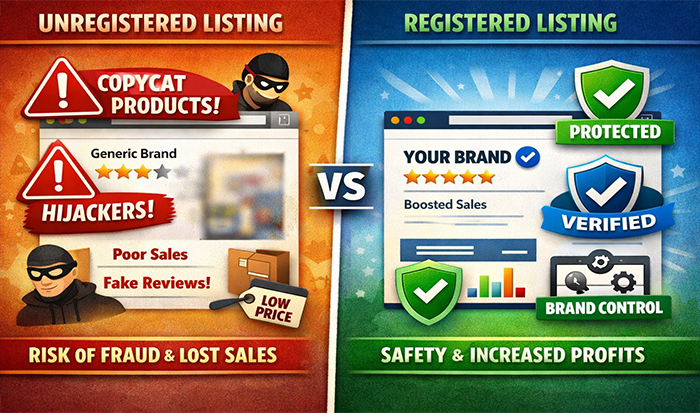
- Killing the Counterfeit Bots
We’ve seen a massive surge in AI-driven fake listings this year. The only real way to fight back is to get on Brand Registry on Amazon. Their machine-learning tools now scan billions of daily listings to kill the fakes before they even go live. For anyone using Amazon Brand Registry Services, this means you can finally stop spending hours sending manual takedown requests.
- Locking Your “Digital Shelf”
There’s nothing worse than a random “hijacker” changing your product title to something gibberish or swapping your hero image. Brand Registry on Amazon gives you a “Catalog Lock.” You – and only you – decide how your brand is presented, ensuring your voice stays consistent from your Shopify storefront all the way to the Amazon search results.
- The Data “Cheat Sheet”
The “Search Query Performance” tools inside Amazon Brand Registry Services are basically a roadmap for your business. You can see the exact Amazon keywords where you’re losing “click share” to the competition and track exactly what else your customers are putting in their carts.
The 2026 Verdict
Establish your vibe on Shopify, but immediately lock down your territory with Brand Registry Amazon. Use those “Shield” protections to keep the copycats away, and use the “Home” data from Shopify to build a brand people actually remember.
Frequently asked questions
1. Is Shopify better than Amazon for new brands?
It depends on your goal. The advantage is total brand ownership and 0% marketplace commission, while the downside is that you need to invest in acquiring every customer yourself. Amazon provides built-in traffic, while Brand Registry on Amazon helps protect your brand.
2. How does Brand Registry stop "listing hijackers"?
Once you enroll in Brand Registry Amazon, you get “Brand Catalog Lock.” This means only you can edit your product titles, images, and descriptions. It stops unauthorized sellers from changing your content or piggybacking on your hard-earned reputation.
3. What are the top Amazon Brand Registry Benefits for sales?
The biggest game-changers are A+ Content (visual storytelling) and Brand Analytics. These tools allow you to see exactly what customers typed to find you, helping you optimize your listings on both Amazon and your Shopify storefront.
4. Can I use Amazon Brand Registry Services without a trademark?
Not permanently. You need a registered (or pending) trademark. However, an Amazon Brand Registry Search through the “IP Accelerator” program can get you early access to protection tools while your legal paperwork is still in progress.
5. Why do brands use both Shopify and Amazon?
It’s a “Fortress Strategy.” Use Shopify to build a loyal community and collect emails, then use Brand Registry on Amazon to capture massive search volume and block counterfeiters from stealing your market share.


