








 AMZ Sales Booster

















 Avg. +47% organic sales
 HELP CENTER



- Introduction
- What Is Amazon Competitor Analysis?
- Why Amazon Competitor Analysis Is Important
- Identifying Your Amazon Competitors
- How to Analyze a Competitive Product on Amazon
- Amazon Competitor Keyword Research
- Amazon Seller Competitor Analysis: Pricing and Promotions
- Review and Rating Analysis
- Amazon Competitive Research for Listing Optimization
- Advertising Insights from Amazon Competitor Analysis
- Tools for Amazon Competitor Analysis
- Common Mistakes to Avoid
- Turning Insights into Action
- Conclusion
- Frequently asked questions
Introduction

Just posting a product will not guarantee long-term success in the competitive Amazon market of today. Since many sellers are fighting for customers’ trust, exposure, and pricing advantages, it is essential to understand how your competitors behave. Amazon competition research turns into a potent tactical tool in this situation. Sellers can make data-driven decisions that increase ranks, conversions, and profitability by carefully examining rival listings, keywords, pricing tactics, and customer feedback.
Panda Boom’s thorough guide will bring you through every facet of Amazon competitor analysis, from finding rivals and Amazon competitor keywords to doing in-depth competitor product analysis and applying insights for long-term success.
Gaining proficiency in Amazon competitive research can provide you with a big advantage, regardless of your level of experience as a seller.
What Is Amazon Competitor Analysis?
The act of investigating and assessing rival sellers and goods in your niche is known as Amazon competition analysis. Understanding how rivals draw in traffic, close deals, and hold onto their ranks is the aim. This includes examining their product listings, pricing, reviews, photos, keyword strategy, backend optimizations, and advertising strategies.
Sellers can find opportunities for distinction, spot market gaps, and steer clear of expensive blunders with the aid of effective Amazon competitive research. You build your strategy on validated data from top-performing competitors rather than speculating about what could work.
Why Amazon Competitor Analysis Is Important

Merchants must assess the competition in order to comprehend the tactics employed by Amazon’s best-selling products. By examining the price, keywords, listings, and reviews of competing sellers, vendors can spot opportunities, enhance their own product presentations, and make informed decisions that increase visibility, sales, and their overall success in the market.
The Significance of Amazon Competitor Analysis
1. Improves Rankings for Keywords
You can find high-converting search terms that Amazon competitors are currently ranking for by investigating competitor backend keywords. If you include these details in your listing, you can experience a rise in visibility and organic traffic.
2. Improves the Positioning of Products
You can determine the advantages and disadvantages of rival products by conducting competitor research. You may improve your USPs and provide a stronger offer with the help of this information.
3. Raises Conversion Rates
You may optimize your listing for more conversions by seeing how competitors organize their headlines, bullet points, photos, and A+ content.
4. Supports Pricing Strategy
Pricing patterns, discount tactics, and perceived value are all revealed by a comprehensive Amazon seller competitor research, which enables you to set competitive prices without compromising margins.
5. Lowers the Risk
You reduce the risk of launching or developing a product without market validation by taking lessons from the successes and failures of competitors.
Identifying Your Amazon Competitors
Prior to examining your rivals, you need to accurately recognize them. Not all sellers of comparable goods are genuine competitors. You can determine who is leading in your product category by identifying your Amazon rivals. Look for ways to increase your own sales and visibility by examining their listings, prices, and reviews.
Direct Competitors
These vendors target the same audience and keywords while selling identical or nearly identical products in your sector.
Indirect Rivals
These goods can target a somewhat different market or offer a different FBA solution to the same issue.
To determine rivals:
To identify competitors:
- Search your primary keyword amazon competitor analysis on Amazon
- Examine the top-ranked sponsored and organic listings.
- Note brands with consistent visibility across multiple keywords
These listings form the foundation of your Amazon competitive analysis.
How to Analyze a Competitive Product on Amazon
Divide your study into organized parts in order to examine a rival product effectively:
Product Title Analysis
- Length and keyword placement
- Use of primary and secondary keywords
- Brand positioning
Bullet Points and Description
- Benefits vs features
- Use of persuasive language
- Formatting and readability
Images and Visual Content
- Image quality and resolution
- Use of infographics
- Lifestyle images vs plain product shots
A+ Content
- Brand storytelling
- Comparison charts
- Trust-building elements
A strong competitor product analysis reveals exactly why certain listings convert better than others.
Amazon Competitor Keyword Research
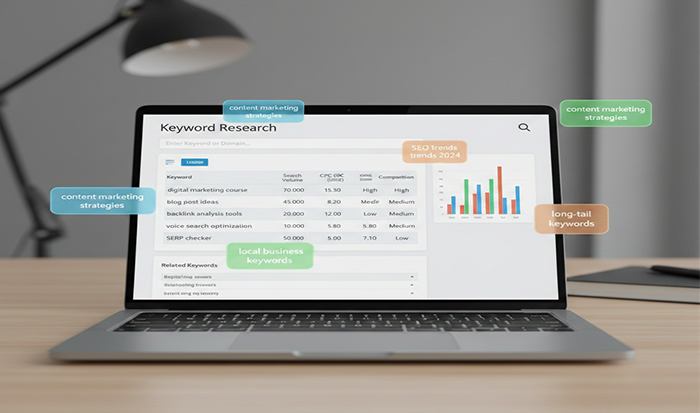
Keyword research is the foundation of every Amazon competitive research strategy. You may determine what consumers are really looking for, spot high-demand prospects, and enhance your own product listings to increase visibility, ranks, and sales by examining the keywords your rivals are using.
How to Locate Amazon Rivals’ Keywords
- Determine which competitor listings rank highest.
- Analyze their titles, bullets, and descriptions
- Review backend keyword strategies (via tools)
- Identify recurring and high-volume terms
Types of Keywords to Look For
- Primary keywords (high volume, high intent)
- Secondary and long-tail keywords
- Buyer-intent phrases
Discoverability and relevance are increased when your listing organically incorporates Amazon competitor keywords.
Amazon Seller Competitor Analysis: Pricing and Promotions
Buyer decisions are heavily influenced by pricing. An effective Amazon seller competitor analysis includes:
- Average price range
- Discount frequency
- Coupon usage
- Subscription or bundle offers
Rather than just cutting prices, you can highlight value and stay competitive by understanding pricing trends.
Review and Rating Analysis

Reviews from customers give clear insight into what consumers enjoy and do not like.
What to Analyze in Reviews
- Common complaints
- Frequently praised features
- Quality and durability feedback
- Packaging and delivery issues
You may outperform rivals and raise consumer happiness by filling in these gaps.
Amazon Competitive Research for Listing Optimization
You can improve your own listing by using the following strategies, which are derived from
Amazon competitive research:
- Using high-performing keywords to refine titles
- Adding benefit-driven messaging to bullet points
- Improving images based on competitor benchmarks
- Strengthening A+ content for brand trust
This approach ensures your listing meets—and exceeds—market expectations.
Advertising Insights from Amazon Competitor Analysis
Competitor research is not limited to organic rankings. Sponsored ads provide valuable insights.
Key Advertising Metrics to Observe
- Sponsored placements
- Keyword overlap
- Ad copy messaging
You may improve targeting and increase ROI by being aware of competing ad strategies.
Tools for Amazon Competitor Analysis
While manual research is useful, tools make Amazon competitive analysis faster and more accurate.
Common capabilities include:
- Keyword tracking
- Listing comparison
- Pricing history
- Review sentiment analysis
When tools are used in conjunction with manual observation, deeper insights are obtained.
Common Mistakes to Avoid

- Copying competitors without differentiation
- Ignoring customer feedback
- Overusing keywords unnaturally
- Focusing only on price competition
A successful competitor product analysis focuses on improvement, not imitation.
Turning Insights into Action
The true value of Amazon competitor analysis lies in execution. After gathering data:
- Update listings strategically
- Enhance the packaging or characteristics of the product
- Modify promotions and prices
- Make advertising campaigns more effective
You can remain ahead of developments in the market by conducting regular analysis.
Conclusion

Sellers who wish to create profitable, long-lasting firms must comprehend Amazon rival analysis. From identifying competitors and identifying Amazon competitor keywords to doing a thorough analysis of Amazon seller competitors, each phase offers useful information that promotes growth.
Sellers may outperform rivals, optimize listings, and scale with confidence by utilizing systematic Amazon competitive research and strategically implementing findings. To remain competitive in the always changing Amazon marketplace, Panda Boom advises making competition analysis a continuous effort rather than a one-time undertaking.
Amazon competition analysis can become your road map to long-term success with the correct strategy, resources, and implementation.
Frequently asked questions
1. What is the most important factor for Amazon SEO?
The key element is Sales Velocity (the speed at which your product is sold). Amazon’s goal is to make money, and it promotes the products that are proven to convert clicks into purchases. You must first get indexed with keywords, but you only climb the ranks by selling consistently.
2. Is it better to use A9 or A10 algorithm for Amazon SEO?
The terms A9 and A10 refer to different iterations of Amazon’s search system. The A10 algorithm is the current, more advanced system. It places more importance on organic sales, external traffic, seller authority, and overall customer experience than the former A9 system, which concentrated more on basic keyword matches and sales numbers. Sellers should always optimize for the A10 principles.
3. Where should I put my keywords on an Amazon listing?
Incorporate high-traffic keywords within the product title and bullet points, and place secondary terms in backend search terms to avoid overloading customer-facing content with keywords.
4. Do Amazon reviews help with SEO?
Absolutely! Even though reviews are not necessarily a ranking factor like sales (direct) they are key in improving your CR and CTR. A product boasting a star rating attracts more clicks and generates more sales; each of these factors contributes to boosting your product’s SEO ranking.
5. Is it advisable to utilize Amazon PPC ads for improving SEO?
Amazon PPC (Pay-Per-Click) can definitely improve SEO, but it should be used strategically. Running PPC ads against high-converting keywords will create the initial sales velocity you need to generate purchases.When you make sales from a high-quality ad click, the Amazon algorithm sees this as a strong performance signal and often rewards that product with better organic search placement over time.


