








 AMZ Sales Booster

















 Avg. +47% organic sales
 HELP CENTER

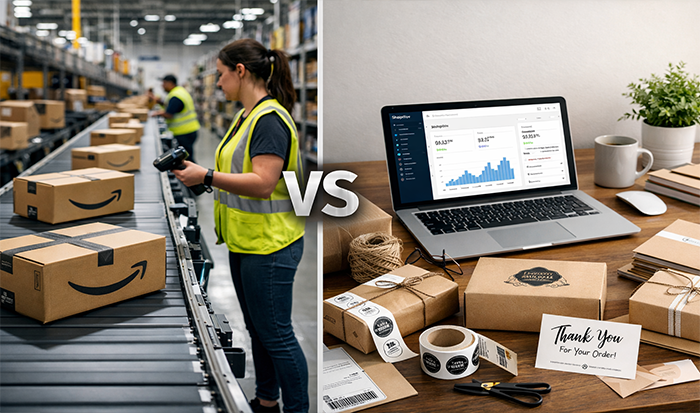

Introduction

Choosing between Amazon FBA and Shopify is one of the biggest challenges for people who are building their online brand. Both are powerful tools or ecommerce models that help in serving fundamentally different purposes.
So, whether you are launching your first online store or scaling an existing venture, then you have to understand Amazon FBA Vs Shopify, Shopify Vs Amazon FBA, and how this platform works.
What is Amazon FBA?
When you’re looking into What Is Amazon FBA, you’re essentially looking at a powerhouse logistics partner. It stands for “Fulfillment by Amazon,” and it’s a game-changer for entrepreneurs who want to scale without tripping over boxes in their living room.
Essentially, you find the products, and Amazon handles the “heavy lifting”—storage, packing, shipping, and even those pesky customer reviews.
But as you grow, you’ll inevitably hit the big debate: Amazon FBA Vs Shopify. One offers a ready-made audience, while the other gives you the keys to your own digital kingdom.
Understanding the Amazon FBA Business
The Amazon FBA Business model is built for speed. When you use FBA Amazon, your products automatically get that coveted “Prime” badge. This isn’t just a label; it’s a trust signal that tells millions of shoppers they can have your product in their hands by tomorrow.
How it Works:
- Ship to Amazon is the first step: Here, you need to send your inventory to an Amazon fulfillment center.
- Storage: They store your items in their massive warehouses.
- The Sale comes next: In this case, your customer buys your product on the Amazon marketplace.
- Fulfillment is another thing: In this case, Amazon picks, packs, and ships the order so that’s easy for you.
- Support is the final stage: Here, they handle customer service and returns.
The Real Talk on Amazon FBA Fees
It’s not a free ride. Amazon FBA Fees are a critical part of your margins. You’ll typically encounter:
- Referral Fees: A percentage of the sale price (usually around 15%).
- Fulfillment Fees: A per-unit cost for the picking, packing, and shipping.
- Storage Fees: Monthly costs based on the volume (cubic feet) your goods occupy.
Expanding Your Horizons: What Is Shopify?
While Amazon is a marketplace where you’re a “tenant,” What Is Shopify? It’s a Shopify Ecommerce Platform—a tool that lets you build your own branded store from scratch.
If Shopify Vs Amazon FBA was a real estate analogy, Amazon is a booth in a busy mall, while Shopify is your own standalone flagship store on the high street.
Benefits of Shopify
The Shopify Benefits center around one thing: Control.
- Brand Identity: You choose the colors, the fonts, and the “vibe.”
- Customer Data: You own your email list. On Amazon, those are Amazon’s customers; on Shopify, they’re yours.
- No Direct Competition: On your site, the shopper isn’t seeing a “sponsored” ad for a cheaper competitor right under your product description
How Amazon FBA Works?
The 2026 Crossroads: Amazon FBA Vs Shopify
When you start an online business today, you aren’t just picking a platform; you’re picking a lifestyle. The biggest fork in the road is almost always Amazon FBA Vs Shopify. One is about leveraging a giant’s momentum, while the other is about carving out your own corner of the internet.
If you’re feeling torn, it helps to look under the hood of how both actually operate in the real world.
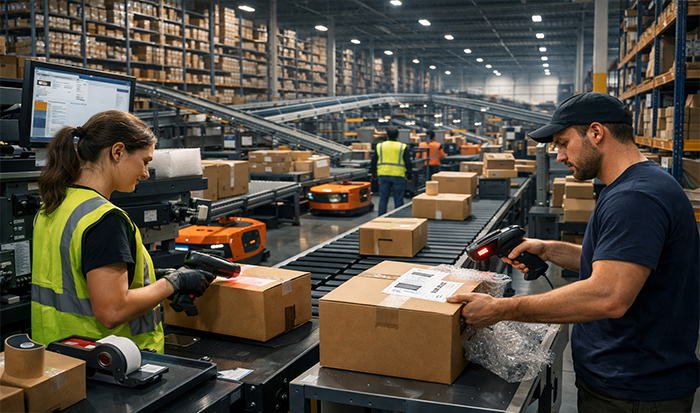
The “Scale-Fast” Route: How Amazon FBA Works
So, What Is Amazon FBA? Think of it as outsourcing your entire back-of-house operation to a logistics titan. Under the Amazon FBA Business model, you handle the sourcing, and they handle the “stuff.”
You ship your products to a fulfillment center, and from that moment on, your hands are mostly clean.
When a customer buys your product, FBA Amazon takes the wheel. They pick the item, pack it in that familiar brown box, and ship it out—usually arriving in 24 hours thanks to that Prime badge.
This speed is why many beginners flock here; it’s hard to beat the trust of a Prime logo. But there’s a trade-off. Amazon FBA Fees can be a bit of a shock if you haven’t crunched the numbers.
Between referral cuts, storage costs, and fulfillment charges, Amazon often takes a 30% to 40% bite out of your revenue. It’s a high-volume, lower-margin game where you trade control for pure, unadulterated speed.
The “Owner’s” Path: How Shopify Works
Now, let’s flip the script. What Is Shopify? It isn’t a marketplace; it’s a Shopify Ecommerce Platform—a toolkit that lets you build a standalone brand. On Amazon, you’re a listing; on Shopify, you’re a destination.
The Benefits of Shopify are rooted in freedom. You own your customer’s email address, you decide the “vibe” of the store, and you don’t have competitors’ ads popping up on your own product pages.
This is the essence of Shopify Benefits: you are building an asset that you actually own. However, looking at the Shopify Vs Amazon FBA reality, the “cons” are real too. You have to bring your own traffic. No one is stumbling upon your store by accident; you need to master SEO, social ads, or influencer partnerships to get the gears turning.
Deciding Your Strategy: Shopify Vs Amazon FBA
When weighing the Shopify Pros and Cons, the biggest “pro” is your profit margin—you aren’t paying those heavy Amazon referral fees. But the biggest “con” is the technical and marketing weight on your shoulders.
Ultimately, the Pros and Cons of Shopify suggest it’s for those building a legacy brand. Amazon FBA is for those who want to validate a product and scale to millions of eyeballs overnight. Most veterans in 2026 don’t actually choose; they use Amazon for the reach and Shopify for the relationship.
The Invisible Reality of the Amazon FBA Business
When we talk about Amazon FBA, we often focus on the logistics. But the real human experience of running an Amazon FBA Business is about playing a high-stakes game of “King of the Hill.”
Because what is Amazon FBA at its core? It’s a data-driven meritocracy. If you have a great product and your “listing health” is high, Amazon’s algorithm will reward you with a flood of customers you didn’t have to pay a dime to acquire.
However, the “human” cost is the lack of sleep over algorithm changes. When you rely on FBA Amazon, you are living in a house owned by Jeff Bezos. He can change the locks (or the search rankings) whenever he wants.
This is why understanding Amazon FBA Fees is so vital. It’s not just about the money; it’s about calculating the “rent” you pay for access to the world’s most powerful buying machine. You trade your brand’s voice for a seat at the table where the customers are already hungry.
Crafting a Legacy: The Shopify Ecommerce Platform
Now, let’s talk about the emotional side of the Shopify Ecommerce Platform. When you sit down to design your store, you aren’t just filling out form fields.
You are choosing the colors that represent your vision. You are writing a copy that speaks directly to a human being, not an algorithm.
The Shopify Benefits are often invisible in the first month. You might launch crickets. But the first time a customer signs up for your newsletter or leaves a glowing review on your site, it feels different.
That is the “human” win of the Shopify Vs Amazon FBA debate. On Shopify, you get to see the face behind the order. You get to send a personalized thank-you note. You get to build a community.
Deep Dive: Shopify Pros and Cons
If we’re being brutally honest about the Pros and Cons of Shopify, we have to talk about the “loneliness” of the platform. Unlike the Amazon FBA Business, where the traffic is a constant stream, Shopify is a desert until you build an oasis.
- The Struggle (Cons): You will spend hours obsessing over “Abandoned Carts.” You will likely struggle with Facebook or TikTok ads. You will realize that being a “Shopify Owner” actually means being a Marketer, a Designer, and a Customer Service Rep all at once.
- The Reward (Pros): You aren’t just selling a commodity; you’re building an asset. If you ever want to sell your business, a Shopify store with a loyal email list is often worth significantly more than a generic Amazon listing. This is one of the most overlooked Shopify Benefits.
The 2026 Hybrid Strategy: Why Not Both?

In the current market, the Shopify Vs Amazon FBA rivalry is actually becoming a partnership. The most successful people I talk to aren’t choosing one; they are using both to balance their “energy.”
They use Amazon FBA to move volume. They send 500 units to a warehouse, let the Prime badge do the work, and use the profit to fund their Shopify ads. Meanwhile, they use their Shopify Ecommerce Platform to test new products and tell their brand story. This hybrid approach mitigates the risk of the Amazon FBA Fees while giving them the security of an independent storefront.
The Final Verdict: Finding Your Fit

When you ask What Is Shopify or What Is Amazon FBA, you’re really asking: Who do I want to be today?
Do you want to be the person who optimizes systems, masters the Amazon SEO game, and enjoys the hands-off nature of FBA Amazon? Or do you want to be the person who builds a culture, designs an experience, and takes the Pros and Cons of Shopify head-on because you value your independence?
There is no “wrong” answer, only the answer that fits your current season of life. As you look toward your birthday and check back in on this “energy,” remember that businesses are living things. They grow, they shift, and they evolve just like we do.
Frequently asked questions
1. What is Amazon FBA exactly, and how does it differ from a Shopify Ecommerce Platform?
Amazon FBA is a service where Amazon stores, packs, and ships your products for you, while Shopify is a platform that lets you create and manage your own online store and handle fulfillment yourself (or via third parties).
2. When comparing Shopify vs Amazon FBA, which one is better for beginners?
Amazon FBA is usually better for beginners because it gives instant access to customers and handles storage, shipping, and returns.
3. What are the main Amazon FBA Fees I should look out for in 2026?
Referral fees, FBA fulfillment fees, monthly storage fees, long-term storage fees, and return or removal fees.
4.Can I use FBA Amazon and Shopify together?
Absolutely—and in 2026, most “pro” sellers do. You can use a “Multi-Channel Fulfillment” (MCF) strategy. This means you sell products on your Shopify ecommerce platform, but you pay Amazon to ship them from their warehouses. It gives you the branding of Shopify with the legendary speed of Amazon logistics.
5. What is the main difference between Amazon FBA and Shopify?
Amazon FBA brings customers and handles fulfillment, while Shopify gives you full control but requires you to drive traffic and manage operations.


