








 AMZ Sales Booster

















 Avg. +47% organic sales
 HELP CENTER



- Introduction
- Is This You? Quick Self-Diagnosis
- Why Amazon Reviews Aren’t Coming In (The Real Reasons)
- What Slow Review Growth Is Actually Costing You
- The Four-Step System to Get More Amazon Reviews
- What Most Sellers Miss
- When It Makes Sense to Get Expert Help
- The Conclusion
- Frequently asked questions
What Slow Review Growth Is Actually Costing You

Most sellers underestimate how expensive slow review growth becomes over time.
Let’s say:
- Your product sells for $35
- Your conversion rate is 10%
- Your competitor converts at 17%
- Both listings receive similar traffic
That conversion gap creates a massive revenue difference over months.
The Hidden Costs of Low Reviews
Low review volume often causes:
- Higher PPC spend
- Lower CTR
- Reduced buyer trust
- Slower organic ranking
- Poor conversion consistency
- Weak launch momentum
Amazon’s algorithm pays close attention to conversion behavior.
Listings with stronger reviews usually:
- Convert better
- Rank better
- Get more traffic
- Generate more sales
- Collect even more reviews
That cycle compounds over time.
The Four-Step System to Get More Amazon Reviews
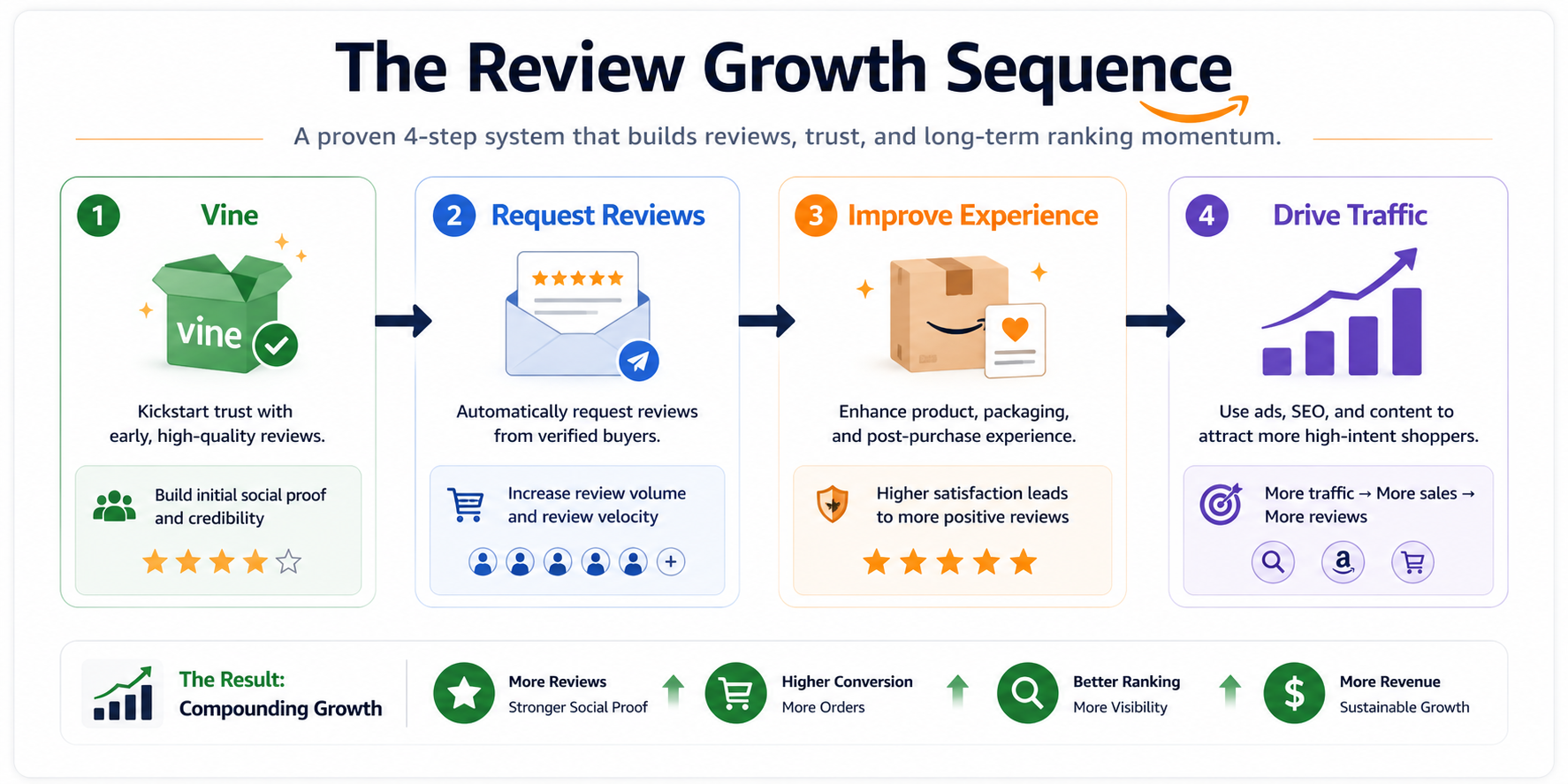
Step 1 – Enroll Eligible Products in Amazon Vine
If you’re enrolled in Brand Registry and your product has low review volume, Amazon Vine is one of the safest ways to get more Amazon reviews early.
Vine allows vetted reviewers to test your product and leave honest feedback.
Why Vine Works
Vine helps:
- Build initial trust
- Increase review velocity
- Improve conversion
- Reduce launch hesitation
Many buyers avoid listings with zero reviews entirely.
Vine helps overcome that initial trust barrier.
What to Expect
- Reviews usually appear within 4–8 weeks
- Ratings are not guaranteed
- Strong products perform best
- Honest feedback improves credibility
This is one of the safest ways to increase reviews for product launches.
Step 2 – Use the “Request a Review” Button Correctly
Amazon’s built-in review request tool is policy-compliant and highly effective when used properly.
The ideal timing is:
- 5–10 days after delivery
Best Practices
- Automate requests consistently
- Filter out returns
- Exclude negative experiences
- Keep timing predictable
Pro Tip
Automated systems help:
- Maintain consistency
- Avoid missed opportunities
- Improve review velocity
- Reduce manual work
This is one of the simplest ways to get more reviews on Amazon safely.
Step 3 – Improve the Product Experience
The goal isn’t just collecting reviews.
The goal is to create experiences buyers want to talk about.
Focus Areas :
-
- Packaging and Unboxing: A better first impression creates emotional engagement.
- Faster Problem Resolution: Quick customer support often converts unhappy buyers into loyal customers.
- Product Quality Consistency: Even great marketing cannot overcome poor product quality in the long term.
- Buyer Education
Simple instructions improve satisfaction significantly.
This helps:
- Build trust for product quality
- Improve ratings
- Increase review consistency
Step 4 – Drive External Traffic to Boost Review Velocity
Once your review system is working properly, external traffic can accelerate growth.
More qualified buyers create:
- More sales
- More reviews
- Stronger relevance signals
Traffic Sources That Help
- Email lists
- Social media audiences
- Influencer campaigns
- Amazon Posts
- Limited-time promotions
- Deal communities
But traffic alone won’t solve weak review systems.
If buyers aren’t reviewing already, scaling traffic simply increases wasted ad spend.
Fix the review process first.
What Most Sellers Miss
Review Velocity Beats Review Count
Most sellers focus only on the total review count.
Amazon also watches:
- Recent review activity
- Consistency
- Buyer engagement trends
A listing with:
- 80 reviews
- 5 new reviews weekly
can outperform a listing with:
- 400 old reviews
- No recent activity
The goal is consistent momentum.
Not short-term spikes.
The Star Rating Threshold That Changes Everything

Star ratings affect conversion dramatically.
The jump from:
- 3.9 stars → 4.4 stars
usually has a much bigger impact than:
- 4.4 → 4.6
Why This Happens
Buyers often use ratings as a trust shortcut.
Products under 4.0 stars create hesitation immediately.
If your rating is below 4.0:
- Fix product quality first
- Improve listing accuracy
- Reduce expectation gaps
More reviews alone won’t solve low trust issues.
When It Makes Sense to Get Expert Help
Review growth involves multiple systems working together:
- Listing optimization
- Buyer trust
- Product quality
- Review timing
- Automation
- Conversion improvement
- Traffic quality
Most sellers struggle because one weak area affects everything else.
If:
- Your review growth has stalled
- You’re stuck below 15 reviews
- PPC costs are rising
- Conversion remains weak
you may need a full review strategy instead of isolated fixes.
Panda Boom helps sellers:
- Get more reviews on Amazon safely
- Improve trust signals
- Increase conversion
- Build sustainable review velocity
- Optimize launch performance
Frequently asked questions
1. Can I ask customers for reviews on Amazon without violating policy?
Yes. Amazon’s Request a Review feature is fully policy-compliant. You simply cannot offer incentives or ask specifically for positive reviews.
2. How long does it take to build reviews on a new Amazon product?
With Vine and a proper review system, many listings reach 30–50 reviews within 60–90 days, depending on traffic and sales volume.
3. Why are my Amazon reviews not growing even though I have sales?
Usually because:
- Review timing is inconsistent
- Buyers aren’t being prompted
- Product experience lacks engagement
- Listing expectations doesn’t match reality
4. What’s the safest way to get more reviews on Amazon?
The safest methods include:
- Amazon Vine
- Request a Review automation
- Better buyer experience
- Improved product quality
5. What matters more: review count or review velocity?
Velocity matters more for long-term ranking because Amazon values recent buyer engagement and consistent demand signals.
The Conclusion
If your Amazon reviews aren’t growing, it’s usually not because your product is bad.
It’s because the review system is weak or incomplete.
Most sellers rely on passive review collection and hope buyers leave feedback naturally. That approach is too slow for competitive categories.
The sellers who consistently get more Amazon reviews focus on:
- Better timing
- Stronger buyer experience
- Consistent review requests
- Review velocity
- Long-term trust building
- Diagnose the bottleneck first.
- Then build the system around it.
If you’d rather not manage the entire process alone, Panda Boom can help build and optimize a complete Amazon review growth strategy designed for long-term ranking and conversion success.


